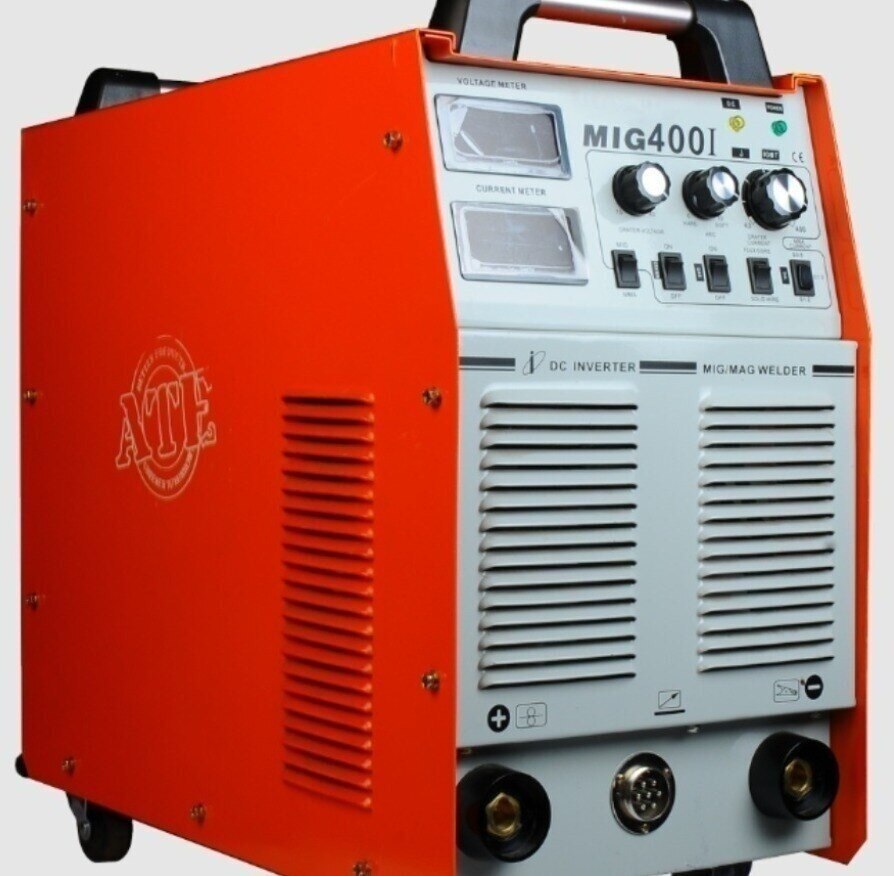
Maximum amperage alone will not identify the right welding inverter for your shop. Compare process capability, rated duty cycle, feeder hardware, electrical supply and job requirements before choosing between dedicated MIG, TIG, combination and multiprocess equipment.
Key takeaways
- Use MIG/MAG for fast, repeatable production welding.
- Choose TIG when finish quality and heat control matter most.
- Check duty cycle, output range, torch functions and consumable access.
- Specify site power, wire sizes and service support before buying.
Compare MIG, MAG and TIG by the work each process must do
Choose MIG/MAG for speed and repeatable production, flux-cored welding for penetration or outdoor work, and TIG for the cleanest, most controlled finish. A useful mig tig welder inverter comparison is:
| Process | Electrode and gas | Speed, finish and operator demand | Best fit |
|---|---|---|---|
| MIG | Solid wire with continuous feed; argon-rich gas for aluminium and argon-CO₂ or CO₂ for steel | Fast deposition, smooth welds and moderate skill; wind can cause porosity | Mild-steel frames, stainless fabrication and nonferrous production |
| MAG | Solid wire with active argon-CO₂ mixture or CO₂ | Fast steel welding; CO₂ gives more spatter and a harsher arc than argon-rich mixtures | General steel fabrication and long production welds |
| Flux-cored | Tubular flux-filled wire; self-shielded wire needs no cylinder, while gas-shielded wire uses its specified gas | High deposition and better outdoor tolerance with self-shielded wire, but slag removal and more fumes add work | Structural repairs, thicker steel and sites where wind disrupts gas |
| TIG | Non-consumable tungsten electrode, argon shielding gas and a separate filler rod | Slowest process, highest finish and greatest hand-control requirement | Thin sheet, stainless details, visible joints and precision repairs |
Most machines sold as MIG equipment in India also support MAG operation. Check the gas chart, polarity and wire program rather than assuming “MIG” means inert-gas welding of aluminium.
For mig welding machine inverter options, record wire diameter and feed speed, not only amperage. Solid steel wire around 0.8–1.2 mm suits common fabrication; flux-cored wire needs compatible drive rolls, liner, contact tip and motor torque. Keep gas flow moderate: excessive flow creates turbulence that pulls air into the shielding zone.
What an inverter changes compared with a transformer machine
An inverter replaces a large 50 Hz transformer with high-frequency electronics, so MIG TIG welder inverter equipment is smaller, lighter and easier to move.
It usually uses electrical power more efficiently, but its circuit boards are less forgiving of dust, heat, moisture and poor service access; transformer machines are heavier, simpler to repair and often more tolerant of rough workshops.
| Option | Practical advantage | Main trade-off |
|---|---|---|
| Transformer | Robust, repairable, tolerant of dirty sites | Heavy, less efficient and less portable |
| Inverter | Lower weight, better portability and controllable arc | Needs thermal protection, clean airflow and accessible replacement boards |
| 40% duty cycle | Welds for 4 minutes in each 10-minute period | More cooling time than a 60% or 100% rating |
| 60% or 100% duty cycle | Supports longer production runs | Costs more and still depends on test temperature and output |
Do not choose from maximum amps alone. IEC 60974-1 expresses duty cycle over 10 minutes: a 200 A machine rated 40% is not equivalent to a 200 A machine rated 60% or 100%, especially at the stated test temperature. Confirm rated output, thermal shutdown and recovery behaviour.
For a mig tig welder inverter in Ahilya Nagar, verify 230 V single-phase or 400 V three-phase, 50 Hz compatibility. Measure voltage sag while welding, then match input current, cable size, protective device and extension length to the manufacturer’s instructions. Size a generator from input power, power factor and efficiency, not kVA alone.
Request the allowable input range, enclosure or ingress information, fan and filter arrangement, and local access to service parts.
Choose among dedicated MIG, dedicated TIG and multiprocess inverter options
Match the architecture to daily workload: dedicated MIG wins repetitive steel production, dedicated TIG wins controlled finish, and multiprocess equipment earns its place only when the shop genuinely changes processes.
| Option | What it means | When it applies |
|---|---|---|
| Dedicated MIG | MIG/MAG power source with purpose-built feeder | Long weld runs, fixtures and repeatable steel production |
| Dedicated TIG | Tungsten-arc machine with TIG controls | Stainless, thin sections, repairs and finish-critical work |
| MIG/TIG combination | MIG and TIG in one package | Mixed repair work with moderate production |
| MIG/TIG/ARC multiprocess | MIG, TIG and stick modes | Mobile work, varied materials and limited machine space |
For mig welding machine inverter options, record wire diameter and feed-speed range, not amperage alone. Steel work commonly uses 0.8, 1.0 and 1.2 mm solid wire. Check feeder roll profile, liner, contact-tip sizes, spool capacity and torch connector together; mismatches cause slipping, bird-nesting and erratic arcs.
A four-roll feeder gives steadier traction through long leads, soft aluminium wire and higher feed rates than a two-roll design. Set roll pressure only high enough to feed reliably. Excess pressure deforms wire, increases liner friction and contaminates the contact tip.
Treat mig welder inverter equipment with pulse MIG, spool-gun compatibility and industrial torch connections as separate checks. Pulse helps control aluminium and thin-section transfer, while a spool gun shortens the feeding path.
For production fixtures or repeatable wire-feed stations, prioritise stored parameters, calibration and long-run stability; a basic combination unit is often a repair machine, not a production platform.
Match output, TIG functions and consumables to common fabrication jobs
A frame shop needs current matched to thickness and arc-on time, not the machine’s peak number. For an industrial MIG TIG welder in Ahilya Nagar, record 230 V single-phase or 400 V three-phase, 50 Hz input, then check voltage sag, input current and duty cycle at the intended load.
| Option | Suitable work | Check before buying |
|---|---|---|
| MIG/MAG | Mild-steel frames and long welds | 0.8–1.2 mm wire, feeder, liner, torch and roll capacity |
| DC TIG | Stainless steel, copper, repairs and controlled thin work | 1.6 or 2.4 mm tungsten, gas-cooled or water-cooled torch |
| AC/DC TIG | Aluminium and magnesium fabrication | AC oxide-breaking control, balance and frequency adjustment |
A useful mig tig welder inverter comparison must include arc-on time: thin sheet and critical pressure components demand stable low-current control, while production frames demand sustained output and a rated IEC 60974-1 duty cycle. A two-roll feeder and short torch suit repairs, not high-volume MIG or long leads.
For TIG, insist on high-frequency start, adjustable pre-flow, post-flow, downslope, remote-current control and a gas-purge connection. Scratch start can contaminate tungsten and gives inconsistent starts.
- DC TIG handles steel, stainless steel and copper; aluminium production needs AC/DC TIG.
- Match polarity: electrode positive for most MIG wire and electrode negative for DC TIG.
- Specify argon for TIG, argon-CO₂ or CO₂ for steel MAG, and root-gas purge for pressure components.
- Reject the unit for critical thin sections or aluminium unless these functions and the required torch are confirmed.
Build a purchase specification for a reliable Ahilya Nagar installation
Put these fields on every quotation request for a mig tig welder in Ahilya Nagar; otherwise, maximum amperage will distort the comparison.
- State material and thickness: mild steel, stainless steel, aluminium, and the minimum and maximum thickness.
- Record the MIG/MAG-to-TIG workload split, expected daily arc-on time, and manual, mechanised, or robotic use.
- Specify 0.8, 1.0, or 1.2 mm wire, tungsten diameter, wire-feed range, feeder type, liner, contact tips, and spool capacity.
- Name the gas: argon, CO₂, or an argon-CO₂ mixture. Require flowmeter or electronic flow control and gas monitoring where production consistency matters.
- State DC or AC/DC TIG, electrode polarity, torch-lead length, torch connector, and the required rated duty cycle on the IEC 60974-1 10-minute basis.
- Confirm 230 V single-phase or 400 V three-phase, 50 Hz input, acceptable supply tolerance, input current, protective device, cable size, and voltage-sag limits.
- For automation, specify the feeder, torch mounting interface, start/stop control, crater fill, wire-feed calibration method, synergic programs, and stored parameters.
- Require digital communication, torch TCP repeatability, and error feedback when a robot or positioner controls the weld. A manual torch-trigger inverter is not automatically robot-ready.
For an industrial mig tig welder in Ahilya Nagar, local engineering support adds value when installation checks, automation interfaces, replacement parts, and service response must sit in one specification. ATE WELDING ENGINEERING ROBOTICS AND AUTOMATION PRIVATE LIMITED can review those interfaces instead of comparing an ampere claim alone.
Related products
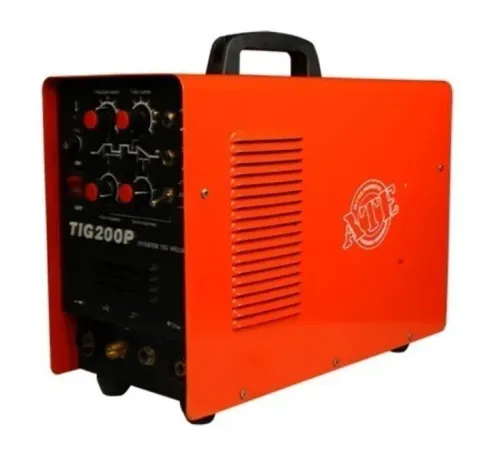
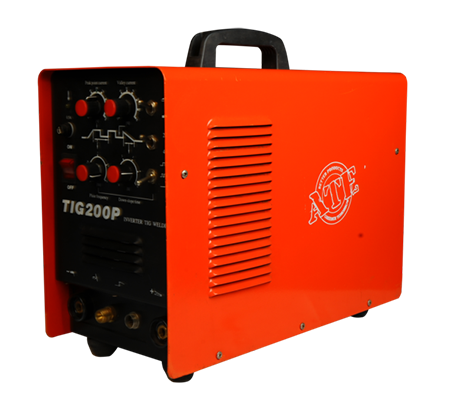 | TIG Welding Machine Precision and High-Quality Welding At ATE Welding Engineering & Robotic Automation, we specialize in TIG (Tungsten Inert Gas) welding machines,... View product → |
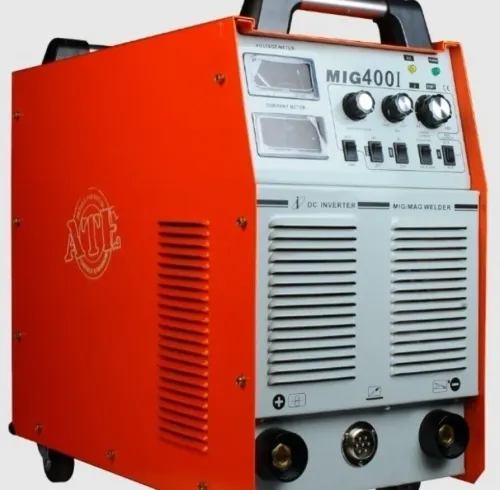
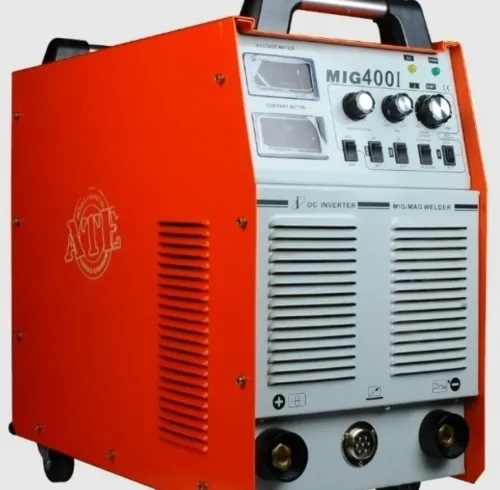
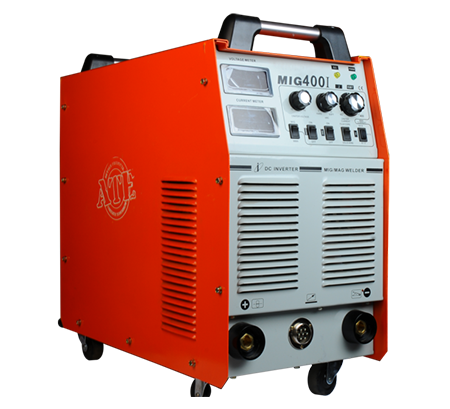 | MIG Welding Machine High-Speed and Versatile Welding Solutions At ATE Welding Engineering & Robotic Automation, we offer advanced MIG (Metal Inert Gas) welding machines... View product → |
Frequently asked questions
What is the difference between MIG, MAG and TIG welding?
MIG uses an inert shielding gas, MAG uses an active gas mixture, and TIG uses a non-consumable tungsten electrode. MIG and MAG suit faster production work, while TIG provides greater control and cleaner finishes.
What does an inverter change compared with a transformer welding machine?
An inverter uses high-frequency electronic switching to reduce machine size and weight while providing tighter control of welding current. Compare its duty cycle, serviceability, power requirements and repair support rather than choosing by weight alone.
Should you buy a dedicated MIG, dedicated TIG or multiprocess inverter?
Choose a dedicated MIG machine for regular wire-feed production, a dedicated TIG machine for precision work, and a multiprocess inverter when your jobs genuinely require MIG, TIG and stick welding from one power source.
What specifications matter when buying a MIG TIG welder inverter?
Match rated output and duty cycle to the material and weld duration. Also check input supply, wire diameter range, spool size, torch type, TIG start method, pulse controls, shielding-gas connections and local service support.