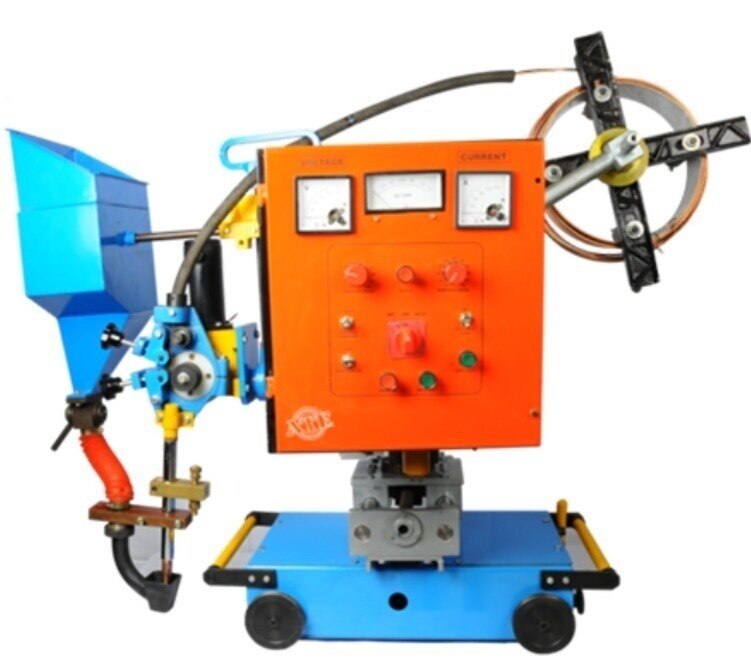
Choosing a SAW system requires more than matching a power-source rating to a plate thickness. You need to confirm that the process suits your joints, calculate the electrical and deposition requirements, and specify the carriage, fixtures, flux handling and controls that keep production stable. By the end, you will have a practical checklist for comparing suppliers and accepting a complete installation.
Key takeaways
- Match single-wire, twin-wire or tandem SAW to the joint and deposition target.
- Specify flux recovery, travel, positioning, extraction and controls with the welding head.
- Compare suppliers using weld procedure evidence, commissioning scope and service response.
- Verify site readiness, operator training and production support before ordering.
How industrial submerged arc welding works and where it fits
A continuous bare wire electrode feeds through a welding head while the workpiece or head travels along the joint. Granular flux from a hopper covers the arc and molten pool, concealing arc radiation and trapping fumes, spatter, and slag.
In ISO 4063, single-wire submerged arc welding is process 121; it is not open-arc MIG/MAG welding with flux-cored wire.
The arc melts the wire, parent metal, and some flux to form the weld. After cooling, remove the solidified slag before inspection or the next pass. Travel direction, wire feed speed, current, voltage, and flux depth control penetration and bead shape.
| Joint type | Fit for SAW | Main limitation |
|---|---|---|
| Long butt or longitudinal seam | Excellent for long, straight plates, shells, beams, and pressure-vessel courses | Needs stable alignment and flat access |
| Circumferential weld | Suitable with a rotator or positioner | Confirm diameter, rotation accuracy, and flux containment |
| Fillet weld | Suitable in the flat or horizontal position | Poor access or forced-position welding reduces suitability |
| Strip cladding | Suitable for broad, repeatable corrosion-resistant overlays | Requires controlled strip feeding and heat management |
Industrial submerged arc welding fits mechanised production where welds are long, accessible, and repeatable. It delivers high deposition with lower operator exposure to radiation and fumes, but its high heat input can increase distortion, residual stress, and burn-through on thin sections. Do not treat an SAW machine as an all-position replacement.
Set the practical plate, seam-length, diameter, and component-size limits through representative trials.
Choose the wire configuration from the job, not the catalogue
Start with the joint cross-section, not the power-source rating. Record plate thickness, groove angle, root gap, weld length, seam diameter, position, required throat or penetration, and the number of passes. These dimensions establish the deposition volume and whether the machine must reach a long longitudinal seam, a circumferential joint, or a restricted fillet.
For a submerged arc machine for production, define the electrical window through a qualified welding procedure, then confirm it with trials. Specify wire diameter, polarity, amperage, voltage, travel speed, wire extension, flux type and feed rate. Excessive heat input can distort thin plate; insufficient heat input can leave lack of fusion in a thick groove.
| Configuration | Best fit | Main trade-off |
|---|---|---|
| Single wire | Moderate deposition and flexible joint work | Lowest power and simplest control, but slower filling |
| Twin or tandem wire | Long seams needing higher deposition | Faster travel, with greater pool size and coordination demands |
| Multi-wire | Very high-volume, heavy-section production | Highest output, power demand, alignment difficulty and qualification burden |
Check that the carriage or manipulator covers the complete seam length and diameter, while the positioner supports the component safely. Select additional wires only when the cycle-time gain justifies a larger power supply, flux system and weld-pool control problem.
Use recorded current, voltage, travel speed and flux-flow alarms; the buried arc hides misalignment until inspection finds it.
Specify the complete station around the welding head
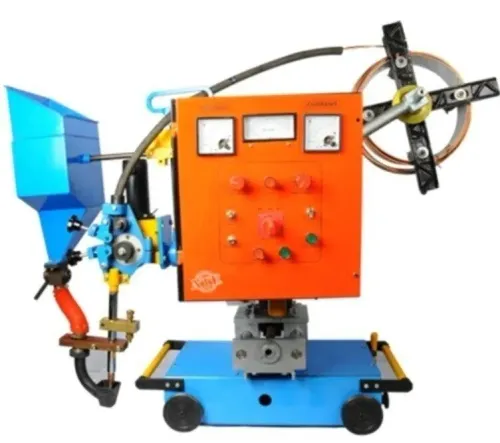
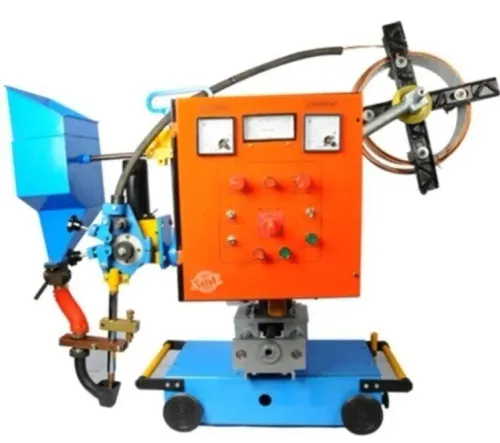
A power source alone cannot make a production cell. Specify the wire-feed head, granular-flux hopper, travel mechanism, workpiece positioner, controls, and recovery equipment as one matched system; otherwise travel speed, arc length, and flux coverage drift between welds.
| Arrangement | Required equipment | Best fit | Main limitation |
|---|---|---|---|
| Fixed head with positioner | SAW head, rotating or tilting positioner, flux hopper, controls | Circumferential seams and repeatable weld lengths | The component must suit the positioner’s load and rotation range |
| Rail-mounted carriage | Welding head, rails, flux hopper, work supports, end stops | Long straight seams on beams, plates, and vessels | Rail alignment directly affects seam tracking |
| Column-and-boom manipulator | Vertical column, boom, head, positioner, height and lateral controls | Large vessels, longitudinal seams, and horizontal fillets | Higher installation and maintenance effort |
Specify these supporting interfaces for a submerged arc welding machine in Pune:
- A wire spool, straightener, drive rolls, contact tip, flux hopper, and flux-level sensing arrangement sized for the selected wire and deposition rate.
- A positioner or carriage with stated payload, rotation or travel speed, working envelope, grounding path, and mechanical stops.
- A control panel that records current, voltage, wire speed, travel speed, flux feed, alarms, and recipe access.
- Flux recovery, screening, drying, and storage equipment if unused granular flux will be collected and reused.
- Guarding, interlocks, fume extraction, slag-removal access, and a commissioning plan covering the manipulator, positioner, and controls. Review equipment and production records against ISO 3834.
Compare SAW suppliers by process control and evidence
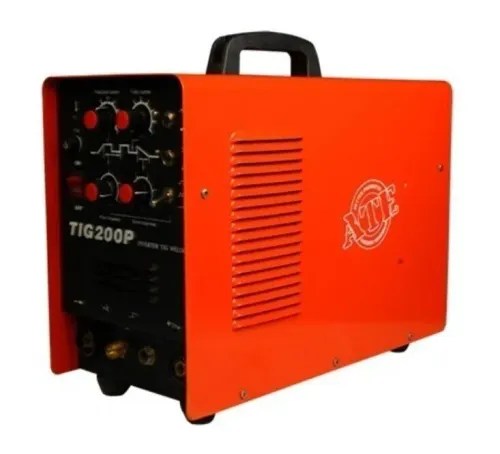
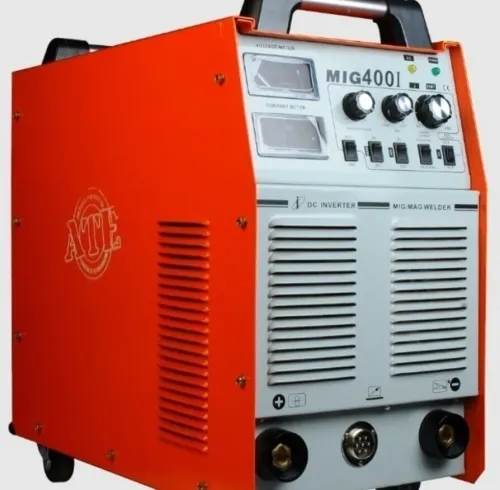
A dependable submerged arc welder supplier proves control of the complete cell, not merely the power source. Check the wire-feed head, flux hopper, travel carriage or manipulator, positioner, controls and flux recovery as one system; a mismatched component can produce unstable penetration despite a capable power source.
| Check | Weak evidence | Strong evidence |
|---|---|---|
| Technical control | Model number and rated current only | Control ranges, feedback method, travel-speed control, alarms, data logging and calibration records |
| Consumables | “Compatible wire and flux” | Complete AWS A5.17 or A5.23 electrode/flux classification, diameter, batch traceability and flux-drying instructions |
| Documentation | Brochure and operating manual | Electrical drawings, pneumatic diagrams, spare-parts list, maintenance schedule, WPS support and ISO 3834 process records |
| Acceptance test | Demonstration on an unrelated coupon | Agreed FAT using your joint, plate, wire, flux and positioner, followed by recorded weld results and corrective actions |
Treat ISO 4063 process 121 as a useful check for single-wire SAW, not proof that every configuration suits your job. Ask how the supplier controls current, voltage, wire-feed speed, travel speed, flux delivery and arc starting under load.
Before purchase, require:
- A representative weld trial with macro examination and agreed dimensional limits
- Repeat runs proving bead consistency, slag detachability and alarm recovery
- FAT and site-acceptance records signed against specified criteria
A supplier that cannot state who supplies the consumables, who calibrates the controls and what evidence closes a failed test has sold equipment, not production assurance.
Verify Pune installation, commissioning and production support
Evaluate the supplier’s Pune support before comparing machine prices. A production-ready partner must demonstrate local installation, commissioning and service capability for the complete system: power source, wire-feed head, flux hopper, travel carriage or manipulator, positioner and controls.
Ask for a site-specific commissioning plan covering electrical supply, floor loading, workpiece handling, safety interlocks, flux recovery and operator training. Reject a quotation that treats the power source as the whole machine.
- Confirm the Pune service contact, response target, stocked spare parts and escalation route for the manipulator, positioner and control system.
- Require a trial weld using your actual steel grade, joint geometry, electrode and flux combination. Record current, voltage, travel speed, deposition rate, bead profile, penetration and slag removal.
- Check continuous output and duty-cycle performance at your proposed current and voltage. A maximum-current figure does not prove sustained production capacity.
- Request operating manuals, electrical drawings, preventive-maintenance schedules, consumable traceability and training records.
- Define acceptance tests for weld quality, travel accuracy, wire feeding, flux delivery, alarms and repeatability before releasing the final payment.
ISO 3834 provides a useful audit frame because it covers equipment, consumables, production, inspection, subcontracting and nonconformance control. Also verify that the quoted electrode and flux classification follows AWS A5.17 for carbon steel or AWS A5.23 for low-alloy steel.
ATE WELDING ENGINEERING ROBOTICS AND AUTOMATION PRIVATE LIMITED should be assessed against this evidence, not merely catalogue availability.
Related product
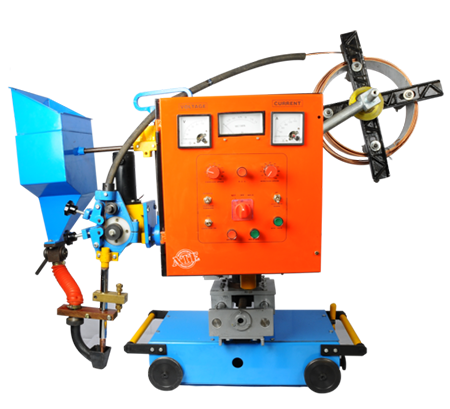 | ARC Welding Machine High-Efficiency Welding Solutions At ATE Welding Engineering & Robotic Automation, we provide advanced Submerged Arc Welding (SAW) machines designed... View product → |
Frequently asked questions
Where does industrial submerged arc welding fit best?
Submerged arc welding fits long, accessible joints that can be positioned for continuous welding, such as pressure vessels, beams, pipes and fabricated steel assemblies. It is a poor fit for short, irregular or difficult-to-access welds.
How should you choose a submerged arc welding wire configuration?
Choose the configuration from the joint, deposition requirement and allowable heat input. Single-wire systems suit straightforward production; twin-wire or tandem systems increase deposition but require tighter control of alignment, power sources, flux and procedure qualification.
What should a complete submerged arc welding station include?
Specify the welding head, power source, wire feeder, flux hopper, flux recovery, travel or positioning equipment, seam tracking, fume control, electrical controls and safety interlocks as one production system.
How can you compare a submerged arc welding machine supplier in Pune?
Ask for comparable weld samples, procedure records, equipment specifications, commissioning responsibilities, operator training details, spare-parts support and response arrangements for your Pune facility.