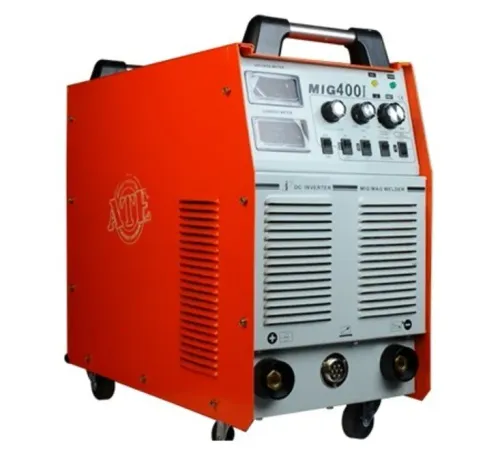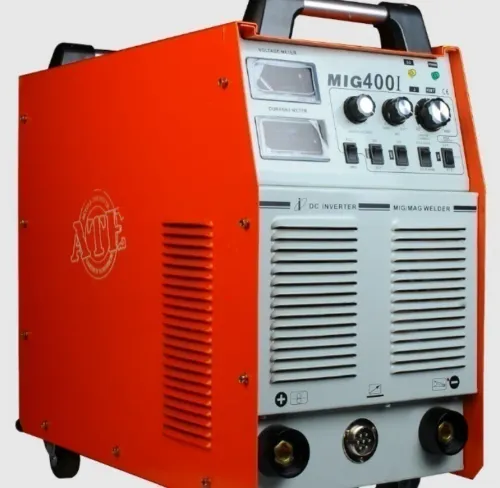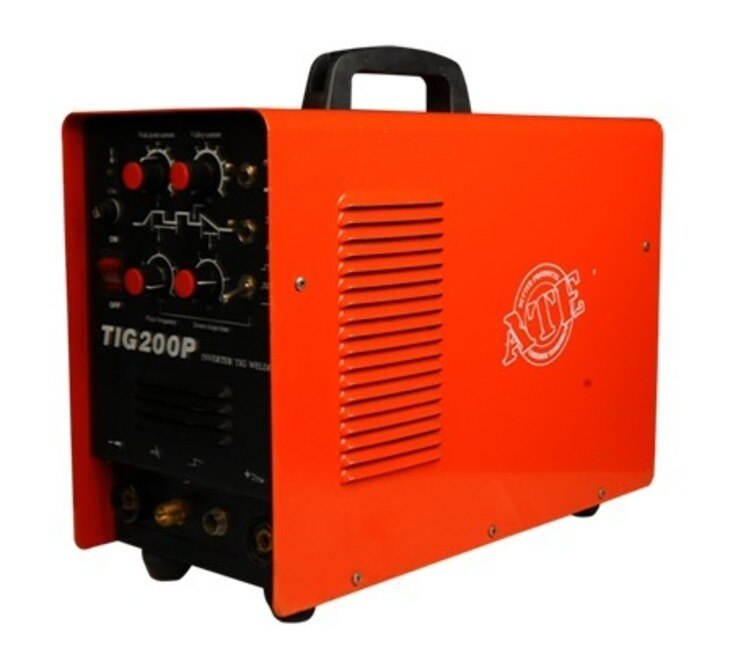
A TIG machine uses a non-consumable tungsten electrode and a separate filler rod to create a controlled, clean weld, while a flux core welder continuously feeds tubular wire and produces a slag-covered bead. You will be able to match each process to your material, joint, work environment, production rate, and equipment requirements before deciding whether one machine can replace the other.
Key takeaways
- TIG uses a non-consumable tungsten electrode and separate filler metal.
- A flux core welder delivers faster deposition and better outdoor performance.
- Choose self-shielded FCAW outdoors; use gas-shielded FCAW for cleaner production welds.
- Compare duty cycle, amperage, wire size, controls, and service support before buying.
What does a TIG welding machine actually use to make a weld?
A TIG welding machine creates a weld with an arc between a tungsten electrode and the workpiece. The torch holds the tungsten, while a work clamp completes the electrical circuit. A shielding-gas cup directs argon or an argon blend over the arc and molten pool, preventing atmospheric contamination.
The tungsten normally remains intact; the operator feeds a separate filler rod only when the joint needs added metal. A TIG welder commonly runs DCEN for steel, stainless steel, nickel alloys, and copper alloys. It uses AC for aluminium and magnesium because the alternating current helps clean their tenacious oxide film.
TIG | Flux-cored welding Electrode | Non-consumable tungsten; filler rod is separate | Consumable tubular wire containing flux Shielding | Argon or an argon blend through the torch cup | Flux creates shielding in FCAW-S; FCAW-G also uses external gas Metal addition | Operator adds filler only when required | Gun continuously feeds wire Residue | No process slag | Slag remains where the selected wire classification requires it
The arc melts the joint edges and any added rod, so TIG offers precise control but demands coordinated torch, tungsten, and filler handling. A flux core welder instead pushes flux-filled wire through a gun, making metal addition continuous.
TIG produces no process slag; flux-cored welding leaves slag that you must remove between passes when the wire classification calls for it.
Can a TIG machine replace a flux core welder?
Only for work that is mainly low-volume, thin-material, precision, root-pass, or appearance-critical welding. A TIG welding machine is not a like-for-like replacement for a flux core welder in production FCAW.
TIG handles filler separately, so travel and deposition are slower than continuously fed FCAW wire. You also need shielding gas, while the operator controls tungsten distance, torch angle, travel speed, and filler addition throughout the weld. That coordination increases labour time, especially on long structural welds.
Before substituting equipment, follow this check:
1. Confirm the power source. TIG normally uses constant-current (CC) output; FCAW normally requires constant-voltage (CV) output, a compatible wire feeder, correct polarity, wire-diameter controls, and an adequate duty cycle.
2. Reject the assumption that amperage proves compatibility. A CC-only TIG or stick inverter cannot run FCAW correctly merely because its rated amperage is high. The machine must specifically provide CV operation and the feeder connections and controls required by the selected wire.
3. Check the qualification documents. A TIG welding procedure or welder qualification does not automatically qualify FCAW work because the processes use different essential variables. AWS D1.1, for example, controls qualification requirements for structural-steel welding; follow its applicable procedure and welder-qualification rules.
Choose TIG when bead appearance, heat control, thin sections, or a controlled root pass matters more than deposition speed. Choose FCAW when high arc-on time, thick material, and production output matter more than a small, highly controlled visible bead.
How do TIG and flux-cored arc welding compare in real production?
TIG suits precision; FCAW suits production volume. A TIG welder uses a non-consumable tungsten, separate filler rod, and external inert gas, while a flux core welder feeds consumable tubular wire continuously.
| Process | Electrode and shielding | Pool control and output | Production result |
|---|---|---|---|
| TIG | Non-consumable tungsten; separate filler; external argon or argon blend | Precise heat and weld-pool control; very low spatter; low deposition rate | Clean, visible beads on thin sections, root passes, and heat-sensitive parts |
| FCAW-S | Consumable flux-filled tubular wire; flux supplies shielding | Effective penetration on thicker sections; higher deposition; more spatter | Strong choice for structural welds, heavy fabrication, and outdoor work |
| FCAW-G | Consumable flux-filled tubular wire; flux plus external shielding gas | Higher deposition with steadier shielding indoors; more spatter | Productive long welds and high arc-on-time fabrication |
TIG demands exceptional coordination: maintain tungsten distance and torch angle, control travel speed, and feed filler separately. It also demands exceptionally clean surfaces; oil, paint, mill scale, and moisture can cause porosity, discoloration, or tungsten contamination.
FCAW normally deposits filler faster and penetrates thicker sections effectively, but slag must be removed between passes and after welding. Its larger, faster-developing pool gives you less control over a small visible bead.
FCAW tolerates minor rust or paint better than TIG, but neither process makes heavy contamination acceptable. Choose TIG when finish and heat control outweigh speed; choose FCAW when long welds, deposition rate, and arc-on time determine the result.
When should you choose TIG, self-shielded FCAW, or gas-shielded FCAW?
Choose a TIG welder for precision, cleanliness, and heat control; choose a flux core welder when deposition rate, thickness, or jobsite conditions matter more than a slag-free finish.
| Option | Material and thickness | Location | Finish and best use |
|---|---|---|---|
| TIG | Stainless steel, aluminium, mild-steel thin sheet, heat-sensitive parts, and reactive alloys such as titanium when the machine and procedure support them | Controlled indoor area | Slow, clean, low-spatter welds; visible beads and controlled root passes |
| Self-shielded FCAW | Structural steel, thick plate, repairs, and joints with minor surface contamination | Stronger outdoor choice because no separate gas cylinder is required | Fast, high-deposition welds with slag; wind can still disturb the arc |
| Gas-shielded FCAW | Structural and low-alloy steel, thick sections, and production work | Productive indoors, protected from drafts | Faster and more controlled than TIG, but produces slag and needs gas shielding |
Pick TIG when the bead will remain visible, the sheet is thin, or excessive heat could distort a part. Use FCAW for long structural welds, thick plate, repair work, and high-deposition production where TIG’s slower travel and separate filler handling consume too much time.
Self-shielded FCAW tolerates outdoor work better, but wind can still cause porosity and unstable shielding. Gas-shielded FCAW gives a controlled arc indoors; drafts can pull air into the gas envelope.
Set FCAW polarity from the wire data sheet and approved WPS, not guesswork. Many FCAW-G wires use DCEP, while many FCAW-S wires use DCEN; reversing them can cause spatter, poor penetration, and unacceptable bead shape.
What should you check before buying an electric welder machine for either process?
A front-panel “TIG” or “multiprocess” label does not prove that an electric welder machine can run both processes. Ask for the following specifications in writing before you buy:
1. For TIG, confirm AC output for aluminium and magnesium, plus DCEN operation for steel, stainless steel, nickel, and copper alloys.
2. Check whether the tig welding machine provides high-frequency starting or lift-arc starting, according to your work requirements. Verify the gas solenoid, post-flow control, torch connection, work-clamp connection, and duty cycle at your intended amperage.
3. Set initial argon flow near 10 to 20 litres per minute. Adjust it for cup size, joint access, and drafts. If welds show porosity or discoloration, check for gas leaks, turbulent flow, contaminated tungsten, excessive torch angle, and inadequate post-flow.
4. For FCAW, confirm both CC and CV modes, wire-feeder compatibility, supported wire diameters, output polarity, spool-gun or gun connections, and the duty cycle at production amperage.
5. If you need gas-shielded FCAW, test the gas-solenoid and flow-control functions. Confirm that the feeder and machine match the selected FCAW-G or FCAW-S wire.
6. Ask for the wire data sheet, connection diagram, and duty-cycle chart. A CC-only TIG or stick inverter cannot become a suitable flux core welder through high amperage alone.
When comparing equipment from ATE WELDING ENGINEERING ROBOTICS AND AUTOMATION PRIVATE LIMITED, use this checklist instead of relying on the process name printed on the front panel.
Related product
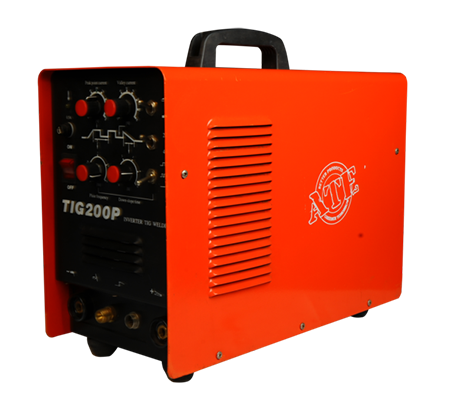 | TIG Welding Machine Precision and High-Quality Welding At ATE Welding Engineering & Robotic Automation, we specialize in TIG (Tungsten Inert Gas) welding machines,... View product → |
Frequently asked questions
What does a TIG welding machine use to make a weld?
It uses an arc between a non-consumable tungsten electrode and the workpiece. Shielding gas protects the arc and molten pool, while filler metal is added separately when required.
Can a TIG machine replace a flux core welder?
Only for jobs where TIG’s precise, clean welds outweigh its lower deposition rate. A TIG machine is not a practical replacement for flux-cored welding in high-volume or thick-section work.
How do TIG and flux-cored arc welding compare in production?
TIG offers superior control and appearance but requires more operator time. FCAW deposits metal faster and suits production work, with self-shielded wire improving portability and gas-shielded wire improving weld cleanliness.
When should you choose TIG, self-shielded FCAW, or gas-shielded FCAW?
Choose TIG for thin materials, stainless steel, aluminium, and visible precision welds. Choose self-shielded FCAW outdoors or where shielding gas is impractical. Choose gas-shielded FCAW indoors for higher productivity and cleaner welds.
What should you check before buying an electric welder machine?
Check process compatibility, output range, duty cycle, input power, wire or electrode sizes, polarity options, control quality, torch and feeder connections, consumable availability, and local service support.