A machine’s maximum amperage tells you little unless it is tied to duty cycle, wire size, travel speed, flux handling and the joint you must weld. Use the checklist below to compare specifications, reject mismatched configurations and define a site acceptance test before you commit to a submerged arc system.
Key takeaways
- Confirm 100% duty-cycle output at your required welding current.
- Match wire diameter, plate thickness and travel speed to production needs.
- Check torch, carriage, flux handling and automation interface compatibility.
- Run a documented weld trial using your actual joint and materials.
Start with the power source and wire-feed specification
A 100% duty-cycle rating at the required current proves far more than a headline maximum amperage. Confirm the source’s continuous output, voltage range, wire diameter range, wire-feed speed, travel-speed range and input supply before comparing submerged arc machine buying details in Pune.
| Power-source option | Output advantage | Confirm before purchase |
|---|---|---|
| DC electrode-positive | Strong penetration and controllable deposition | Rated current at 100% duty cycle, voltage stability and polarity control |
| AC | Reduces arc blow and suits higher total deposition in multi-electrode setups | Available waveform and frequency controls, plus the continuous AC rating |
| DC and AC | Supports different joints, wires and production recipes | Whether each mode works across the stated current, voltage and wire-feed ranges |
Treat deposition-rate claims carefully. Ask whether the figure means net deposited metal or gross wire consumption; arc time, starts and stops, wire stubs, slag removal and flux recovery reduce usable output. A source rated only at 60% duty cycle can force cooling pauses during a continuous production cycle.
Request a documented recipe linking current, voltage, wire-feed speed, travel speed, polarity, electrode stickout, flux type and preheat or interpass limits. For submerged arc welding equipment in Pune, also verify start-permissive signals, emergency-stop integration, travel interlocks, PLC protocol, weld-data logging and independent maintenance operation.
Test the source on the actual cycle and record arc time, heat input, deposition rate and bead dimensions.
Match capacity to the joint, plate and production rate
Plate thickness sets the required penetration, heat input and number of passes. A thin plate can suffer burn-through under an oversized high-current setup, while a thick plate with a narrow-root joint may need multiple passes, a larger wire, higher current or tandem electrodes.
Match the machine to the qualified joint procedure, not to plate thickness alone.
Confirm these production inputs before selecting the configuration:
- Joint type and weld length: butt, fillet, circumferential and longitudinal joints each impose different access, travel and fixture requirements.
- Weld position: flat-position SAW supports the highest practical deposition rates; horizontal fillets and circumferential welds need flux containment, torch alignment and travel control suited to the position.
- Deposition target: compare usable deposited metal with the required kilograms per hour, not the advertised gross wire-feed rate. Arc starts, stops, slag removal and flux recovery reduce output.
- Production cycle: calculate arc-on time, pass count and continuous travel time for the actual component.
Use single-wire welding for moderate deposition and simpler control. Choose tandem or multi-wire SAW when long, accessible welds justify extra power sources, flux delivery and coordination. AC can reduce arc blow in multi-wire arrangements, while DC electrode-positive supports penetration and deposition control.
An industrial submerged welding in Pune acceptance trial must use your plate, joint preparation, position and consumables. Record wire-feed speed, travel speed, bead size, heat input, defects and slag detachability; a showroom bead proves little.
Check the torch, carriage and automation interface
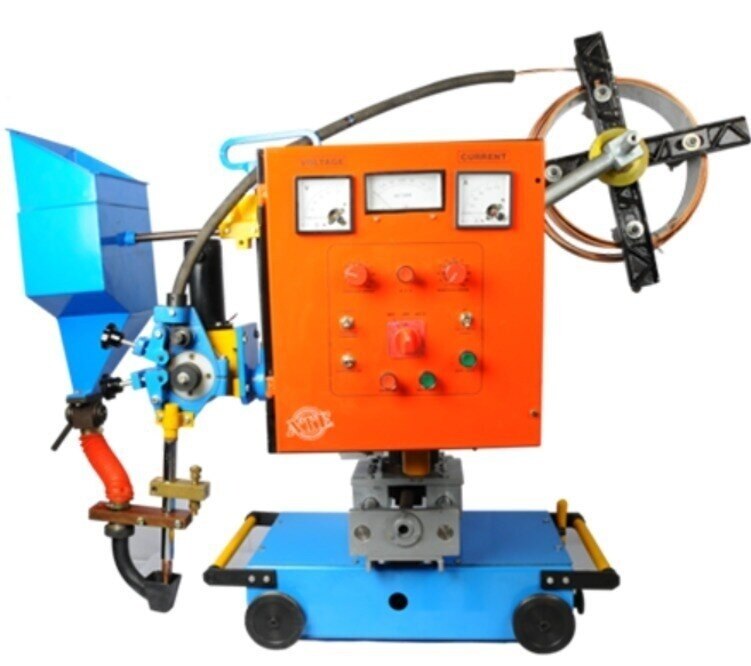
The torch and carriage keep the electrode over the joint; seam tracking and height control correct smaller errors. Confirm tractor travel, boom reach, torch adjustment, wheel configuration and oscillation settings against your fixtures, rotators, manipulators and column-and-boom arrangement. A rigid carriage that cannot follow the workpiece will produce uneven penetration.
Ask the supplier to confirm:
- Usable travel-speed range and the control method that holds speed; excessive speed can cause lack of fusion, while slow travel can create a wide bead or burn-through.
- Seam-tracking type, sensing range and correction limits; automatic voltage control (AVC) adjusts arc voltage or electrode stickout, but it does not replace seam tracking.
- AVC response, torch-height adjustment and compatibility with the selected wire diameter, polarity and flux.
- Start-permissive signals, travel interlocks, emergency-stop integration and communication protocol for the production-line PLC.
- Inputs and outputs for rotator speed, carriage motion, fixture clamping and weld-cycle status.
- Weld-current, voltage, wire-feed, travel-speed and alarm logging, with exportable records for repeat production.
- Independent welding-source operation for setup and maintenance, without forcing the complete line into automatic mode.
Request a documented recipe linking current, voltage, wire-feed speed, travel speed, polarity, stickout, flux type and preheat or interpass limits. A feature search such as “ibell welding machine in pune” cannot establish capability unless those linked controls and interface drawings are available.
Confirm flux, wire and real production conditions
A consistent SAW weld starts with a controlled consumable system, not the power source alone. Obtain a welding procedure or parameter recipe linking current, voltage, wire-feed speed, travel speed, polarity, electrode stickout, flux type, and preheat or interpass limits.
A feature list found under “ibell welding machine submerged arc features” proves little without these linked settings.
Before production, confirm these controls:
- Match the wire and flux to the base metal and procedure standard: AWS A5.17 for carbon-steel electrodes and fluxes, AWS A5.23 for low-alloy steels, or ISO 14171 for unalloyed and fine-grained steels.
- Record wire diameter, batch or lot number, flux designation, and supplier certificate. Do not substitute a similar-looking flux without procedure approval.
- Protect flux from moisture in sealed storage or a controlled drying system. Damp flux can cause porosity, unstable arc behaviour, hydrogen-related cracking risk, and changed weld chemistry.
- Check hopper capacity, metered delivery, flux recovery, screening, and recycling. Return recovered flux only after removing slag, wire fragments, oil, and other contamination.
| Production condition | Confirm before release | Failure if ignored |
|---|---|---|
| Stable travel | Speed range and closed-loop control | Lack of fusion, undersized bead, or excessive heat input |
| Preheat and interpass | Measured limits and temperature records | Cracking or inconsistent penetration |
| Shop floor | Clean joint faces, dry flux, steady fit-up | Porosity and variable bead shape |
| Consumable traceability | Wire and flux lot records | Unrepeatable welds and weak investigation |
A quotation for submerged arc welding equipment in Pune should state these controls plainly, not hide them behind “heavy-duty” language.
Use a documented weld trial to verify quality and support
Run the machine through a witnessed trial using your actual plate thickness, joint preparation, flux-wire combination, welding position and production cycle—not a showroom coupon.
1. Require a signed welding procedure or parameter recipe before the trial. Record current, voltage, wire-feed speed, travel speed, polarity, electrode stickout, flux type, preheat and interpass limits. Include the source’s 100% duty-cycle rating, usable travel-speed range and speed-control method.
2. Log each run’s deposition rate, arc time, measured heat input, bead width and reinforcement. Inspect the weld for undercut, porosity, lack of fusion, cracks and burn-through; check slag detachability and section a macro sample when the joint risk justifies it.
Excessive travel speed can leave an undersized or unfused bead, while low speed can create excessive heat input.
3. Test the start and stop sequence: arc striking, run-in, crater fill, burnback, wire cut-off and end-weld control. Poor settings reveal themselves as arc strikes, crater cracking, end buildup or incomplete fusion at run transitions.
4. Test integration before installation. Confirm communication protocol, start-permissive signals, emergency-stop integration, travel interlocks, weld-data logging and independent maintenance operation with the PLC, column-and-boom system, rotator or manipulator.
For industrial submerged welding in Pune, make the supplier submit the trial report, calibration records, spare-parts list, training scope and response times for service. ATE WELDING ENGINEERING ROBOTICS AND AUTOMATION PRIVATE LIMITED should be assessed against those same documents, not a feature list. Use this evidence for your submerged arc machine buying details in Pune.
Frequently asked questions
Which power-source specifications should Pune manufacturers confirm?
Confirm continuous output at the required current, voltage range, wire diameter range, wire-feed speed, travel-speed range and input supply. Do not compare machines using maximum amperage alone.
How should you match a submerged arc machine to production requirements?
Match capacity to joint design, plate thickness, weld size, wire diameter, travel speed and production rate. A machine with a higher headline rating is not automatically suitable for your work.
What automation features should you check before buying?
Inspect the torch, carriage, flux delivery and recovery system, seam-tracking options, controls and interfaces for integration with your existing line or robotic welding equipment.
Why is a documented weld trial important?
A trial using your actual plate, joint, wire, flux and production settings verifies weld quality, deposition performance, travel speed, operator workflow and supplier support before installation.