A dual-process machine can handle MIG production welds and TIG-controlled work, but it does not turn every job into a faster job. You will be able to map each automotive component to the right process, identify the accessories and specifications required, and calculate whether one shared machine actually improves production.
Key takeaways
- Change the torch, gas, wire system, polarity and settings between MIG and TIG.
- Use MIG for productive structural welds; choose TIG for controlled, clean precision work.
- Check duty cycle, output range, wire compatibility and service support before buying.
- Calculate changeover time, consumables and downtime before consolidating welding equipment.
How one machine changes from MIG to TIG
A dual-process welder does not switch processes by pressing one button. The operator changes the torch, shielding gas, wire system, polarity and programmed settings before welding. The main dual process welder benefits are fewer power sources and less floor space, not fewer consumables or procedures.
1. For MIG/MAG, connect the MIG torch and work clamp, install the correct liner and contact tip, load the wire, select the wire diameter, and use the production gas blend, such as argon–CO2 for mild steel. Set wire-feed speed, voltage, inductance, pulse or synergic mode, and polarity.
2. For TIG, remove or isolate the wire-feed system, connect a TIG torch with a tungsten electrode, and use pure argon with its own regulator and hose arrangement. Select lift or high-frequency start, pre-flow, post-flow, amperage, downslope and, where fitted, foot-pedal control. AC output is required for aluminium; DC TIG covers steel and stainless steel.
3. Purge the changeover. A mixed MIG gas left on a TIG line contaminates shielding, while a blunt or contaminated tungsten creates unstable arcs and visible defects. Record the procedure settings for each material and joint.
4. Check whether the machine offers genuine TIG controls: high-frequency start, stable low-current output, gas timing, current slope control and AC TIG when aluminium work requires it. Limited lift-arc TIG usually provides only contact-free arc starting and basic current adjustment; it is not equivalent to a full TIG function.
A MIG TIG welder for automotive production therefore suits suppliers that alternate between fast steel welds and controlled stainless-steel, aluminium or prototype work. It does not make TIG as fast as MIG.
Match MIG or TIG to the part, material and joint
For anyone searching mig tig for welder benefits automotive suppliers in pune, choose the process from the part, material, thickness and joint—not the machine label. MIG/MAG (GMAW) suits repetitive fillet and lap welds on mild-steel brackets, frames, fixtures and exhaust supports because continuous wire delivers higher deposition and faster travel.
TIG suits thin sheet, visible butt or corner joints, tight root control, repairs and low-volume prototypes.
| Process | Best automotive use | Material and joint guidance |
|---|---|---|
| MIG/MAG | Brackets, chassis parts, fixtures and repeat sheet-metal assemblies | Mild steel fillets and laps; stainless production welds; use pulsed output for thin sheet or controlled heat |
| TIG | Exhaust seams, visible joints, repairs and prototypes | Stainless-steel butt, corner and root joints; thin mild steel; precise heat control but slower production |
| MIG aluminium | Aluminium brackets, housings and repeat assemblies | Use a suitable liner or spool gun; pulsed output helps control spatter and heat on thin sections |
| AC TIG | Thin aluminium parts, prototypes and cosmetic welds | AC cleans the oxide layer and gives arc control; expect lower travel speed |
For mixed work, verify the qualified procedure for each material and thickness under ISO 15614-1; do not transfer settings between steel, stainless steel and aluminium. A dual-process machine reduces floor space, but each job still needs its own torch, liner, shielding gas, filler, polarity and joint-specific settings.
Local support matters when a feeder, torch part or control board stops production.
Specifications that decide production suitability
Production suitability depends on sustained output, not the largest amperage printed on the panel. For an automotive welding machine in Pune, match the machine to your material, joint, takt time, electrical supply and automation plan.
Verify these specifications before purchase:
- Output: maximum current, minimum stable current, voltage range and rated wire diameters.
- Duty cycle: percentage at your required current, voltage, ambient temperature and test standard. A high-ampere machine with a low duty cycle can overheat during repetitive brackets or frames.
- Electrical: input voltage, single- or three-phase supply, frequency, input current, earthing and generator compatibility.
- Wire feeding: feed-speed range, spool size, liner options, drive-roll profiles, aluminium-wire compatibility and support for spool-gun or push-pull feeding.
- Torch: air- or water-cooled rating, cable length, connector type, consumable availability and torch trigger controls.
- Gas: compatible MIG/MAG and TIG gases, flow range, regulator connection and gas pre-flow and post-flow settings.
- Pulse: synergic programs, adjustable pulse frequency, inductance, waveform control and material-specific programs.
- Cooling and storage: thermal protection, fan or liquid cooling, saved welding programs, job recall and USB or network data handling.
- Automation: remote control, robot interface, arc-start signal, wire-feed feedback, analogue or fieldbus communication and error outputs.
| Application | Specification to prove | Failure if missed |
|---|---|---|
| Steel production | Stable MIG/MAG output and duty cycle at production current | Porosity, overheating or stoppages |
| Aluminium TIG | AC output with balance and frequency control | The TIG function cannot weld aluminium correctly |
| Aluminium MIG | Spool gun or push-pull feeder | Soft wire buckles inside the liner |
| Quality-controlled work | Procedure records covering ISO 15614-1 requirements | The brochure cannot support procedure qualification |
Calculate the real benefit before consolidating equipment
A dual-process machine pays for itself only when the saved changeover time and floor space exceed the loss from slower TIG work or shared-machine waiting. Start with one month of actual weld orders, separating MIG length from TIG length rather than averaging both processes.
Record weld length, arc time, changeover minutes, consumable cost, operator hours, utilisation and rework for each option. Use this calculation:
Monthly cost = machine and maintenance cost + labour during arc and changeover time + wire, tungsten, gas and contact-tip cost + rework cost.
| Measure | Dual-process machine | Separate MIG and TIG machines |
|---|---|---|
| Weld length | Add MIG and TIG metres on one machine | Assign each length to its dedicated process |
| Arc time | MIG and TIG arc hours share one power source | Arc hours run in parallel |
| Changeover | Include torch, liner, gas, wire and parameter changes | Count only job or material changeovers |
| Consumables | Include both process sets and purge losses | Include both sets, with less switching waste |
| Operator availability | Charge waiting time when one operator needs the machine | Charge idle time when either machine lacks an operator |
| Utilisation | Calculate arc hours divided by available machine hours | Calculate each machine separately |
| Rework | Multiply rejected metres by labour, consumables and inspection cost | Compare defects by process and equipment |
A dual-process welder benefits a mixed supplier when MIG runs production brackets and TIG handles stainless, aluminium or prototypes. A MIG TIG welder for automotive work is the wrong consolidation choice if TIG queues delay MIG takt time, or if rework from contaminated tungsten and inconsistent manual heat control exceeds the saved equipment cost.
Keep separate machines when parallel production matters more than floor space.
Make the machine fit Pune service and quality requirements
Reject any automotive welding machine in Pune that cannot be supported during a production stoppage. Pune does not require a special MIG or TIG principle; your materials, joint designs, takt time, electrical supply and customer quality requirements determine the machine. Local value lies in commissioning, training, spares and preventive maintenance.
1. Ask for a Pune service plan: technician response time, preventive-maintenance intervals and stock of contact tips, liners, tungsten electrodes, torch parts, rollers, circuit boards and proprietary feeders. A low purchase price is irrelevant if a control board stops production for weeks.
2. Require a welding procedure qualified to ISO 15614-1, with records linking material grade, thickness, joint, filler, gas, current, voltage, travel speed and heat-input limits. Qualify operators to ISO 9606-1 where applicable, and align maintenance, traceability, inspection and nonconformance control with ISO 3834-2.
3. Specify local exhaust ventilation at the arc, fume capture suited to the fixture and a documented airflow check. Verify gas type, regulator, hose and leak checks; excessive flow, leaks and drafts create porosity. Include gas-flow verification in defect diagnosis.
4. For robotic use, confirm digital or analog interfaces, current and voltage feedback, wire-feeder compatibility, torch mounting, collision protection, repeatable parameter recall and communication with the robot controller. Demand a sample weld on your actual joint.
5. Ask ATE WELDING ENGINEERING ROBOTICS AND AUTOMATION PRIVATE LIMITED to separate standard machine capability from optional integration, commissioning, training and spare-part commitments in the quotation.
A MIG TIG welder in Pune earns approval only when its procedure records, fume controls and service response match your customer audit evidence.
Related products
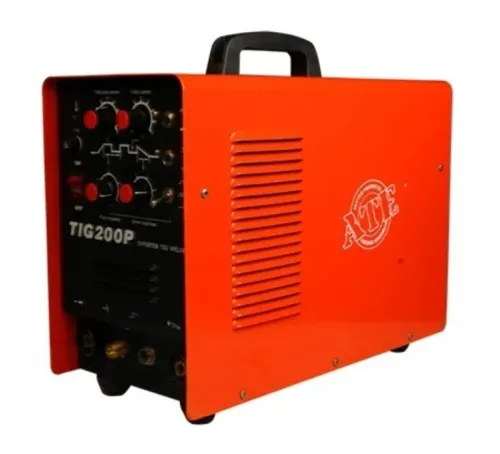
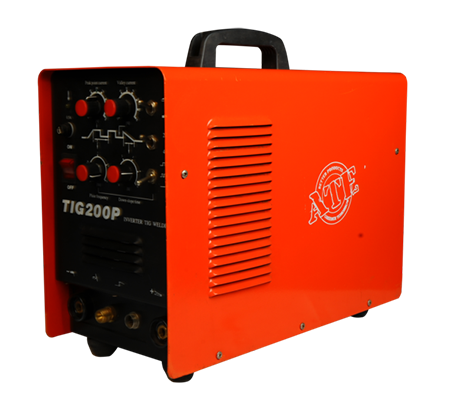 | TIG Welding Machine Precision and High-Quality Welding At ATE Welding Engineering & Robotic Automation, we specialize in TIG (Tungsten Inert Gas) welding machines,... View product → |
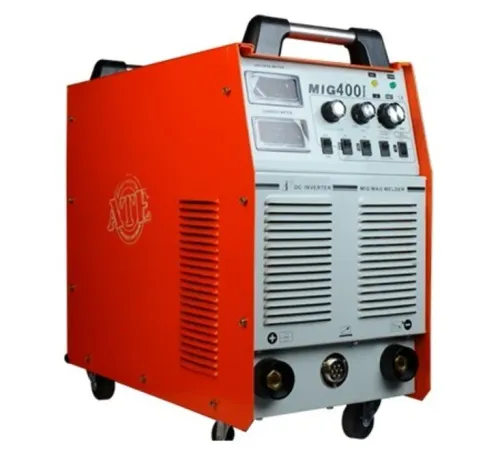
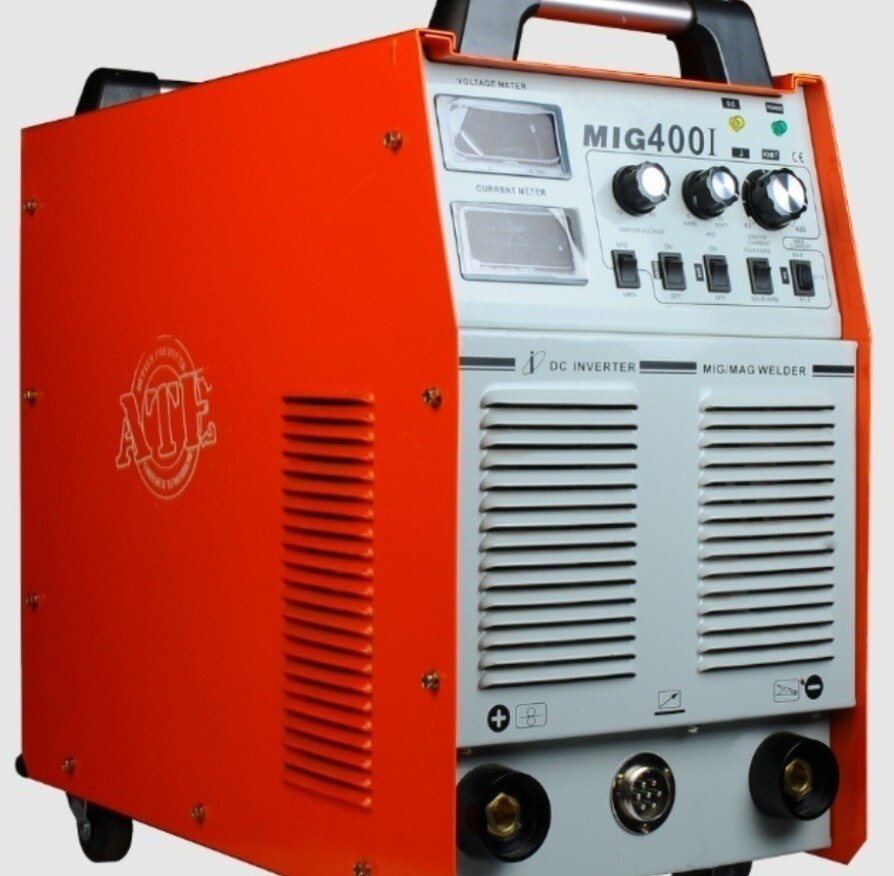
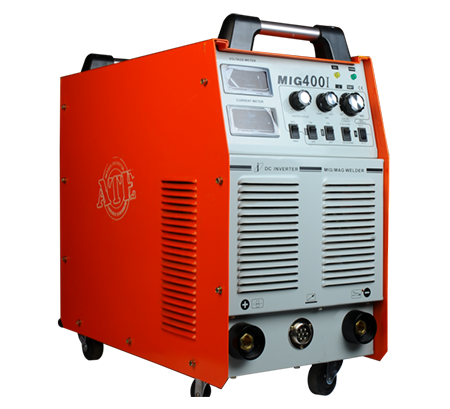 | MIG Welding Machine High-Speed and Versatile Welding Solutions At ATE Welding Engineering & Robotic Automation, we offer advanced MIG (Metal Inert Gas) welding machines... View product → |
Frequently asked questions
How does one machine change from MIG to TIG?
Switching processes requires changing the torch, shielding gas, wire system, polarity and programmed settings; it is not a one-button change.
When should automotive suppliers use MIG instead of TIG?
Use MIG when production speed, deposition rate and repeatable weld volume matter. Choose TIG when you need precise heat control, clean welds or work on thin material.
Which specifications determine whether a MIG-TIG welder suits production?
Compare duty cycle, output range, wire diameter compatibility, torch and cable ratings, gas requirements, control functions, power supply and automation compatibility.
What should you include when calculating the benefit of one dual-process welder?
Count equipment savings alongside changeover labour, consumables, gas-cylinder changes, programming time, downtime and the risk of disrupting production.